AI's Double-Edged Sword
The $25 million video call: every face was a deepfake except yours. AI gave attackers an enterprise budget. Here is how a 50-person company fights back without one. 1 in 4 malicious breaches is now AI-enabled, each costing about $6M on average, and BEC fraud losses hit $3.05B.



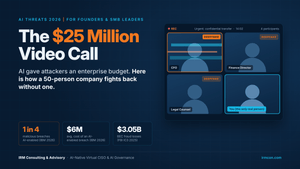
The $25 Million Video Call: AI Gave Attackers an Enterprise Budget. Here Is How a 50-Person Company Fights Back Without One.
In January 2024, an employee in the Hong Kong office of engineering firm Arup joined a video call with the company’s CFO and several colleagues. The request was urgent and confidential. The faces looked right. The voices sounded right. Over the following days, the employee made 15 transfers to five bank accounts, totaling HK$200 million, about US$25 million.
Every other person on that call was a deepfake. When I tell this story to founders, the first reaction is usually relief: “We are not Arup.” That is exactly the wrong conclusion. Two years ago, an attack like that took real effort to stage. In 2026 it takes a few minutes of public video and an off-the-shelf tool. AI has given attackers an enterprise budget.
Most Startups and SMBs are still defending with a part-time plan and a full-time hope. For Startups and SMB's selling to regulated industries such as Financial Services, Healthcare, Defence and Education, the threat has not just grown this year. It has changed shape. Here is what the latest data shows, and what a company of 30 to 300 people can do about it this quarter.
What the 2026 numbers actually say
Breaches got more expensive, and AI is part of why. IBM’s 2026 Cost of a Data Breach Study found that AI-enabled breaches now cost companies about $6 million on average, well above the record global average of $4.99 million. One in four malicious breaches was AI-enabled.
Organizations that used security AI and automation themselves saved an average of $1.93 million per breach. AI is cutting both ways, and the defenders who use it well are pulling ahead.
Fraud is where AI hits Small Companies first. The FBI’s Internet Crime Complaint Center logged $3.05 billion in business email compromise losses in 2025, plus 22,364 complaints involving AI, with reported losses above $893 million. Those are reported losses only. Most small businesses never file.
Attackers move faster than Patch Cycles. Verizon’s 2026 Data Breach Investigations Report found that exploiting vulnerabilities is now the most common way in, at 31% of breaches in its dataset, up from 20% a year earlier. Breaches involving a third party rose to 48%.
The Attacker is increasingly a Machine. In November 2025, Anthropic disclosed what it described as the first reported AI-orchestrated cyber espionage campaign. An AI agent carried out an estimated 80 to 90% of the tactical work against roughly 30 targets, with humans stepping in at only four to six decision points per campaign.
And the AI you adopt is a door, too. In IBM’s 2026 data, 92% of organizations that suffered an AI-related breach lacked proper access controls on their AI systems.
Three (3) Threats that changed shape in 2026
1. Impersonation at industrial scale. Phishing used to be detectable by bad grammar. That tell is gone. AI writes flawless, personalized lures in any language, clones a voice from a podcast clip and puts a convincing face on a video call. The target is rarely your firewall. It is the person who can move money, reset a password or approve a vendor. Fake candidates with synthetic identities are passing remote interviews and getting hired. For a remote-first startup, your next security incident may arrive through your applicant tracking system.
2. Speed that outruns Small Teams. When an AI agent can scan, exploit and move laterally in hours, a monthly patch cycle and a part-time IT lead are not a defence. They are a delay.
3. The AI inside your own Walls. Your team is already using AI Assistants, Browser Extensions, Meeting Recorders, and Coding Agents, many of them never approved/authorized; that is Shadow AI. Each tool is a new place for customer data to leak and, when an agent is connected to email, files or production systems with broad permissions, that is a new identity an attacker can hijack.
Why the Small Business is now the Soft Target
Large enterprises have spent the last two years building AI Governance programs, Red Teams and 24/7 Monitoring. Attackers follow the path of least resistance, and that path increasingly runs through their Suppliers/Third-Party Providers. Your enterprise customers are sending Security Questionnaires with new sections on AI.
Your Cyber Insurer is asking how you verify payments and control AI Tools. Your investors will ask in due diligence. And the math is brutal: a $5 million breach is a rounding error for a Fortune 500 company and an existential event for a business doing $10 million in revenue.
The good news is the advantage that small companies rarely use. An enterprise needs two years and a steering committee to change a control. Small companies can decide it on Monday and have it running by Friday.
The Gap is Leadership, not Tools
Across our assessments, the pattern repeats. The company has bought tools. It has an endpoint agent, an email filter and maybe a compliance platform. What it does not have is a person who owns the risk: who decides what AI tools are allowed, who signs off on the payment rule, who answers the enterprise questionnaire with confidence, and who runs the room when something goes wrong.
Most companies under 300 people cannot justify one full-time CISO. Our ROI model uses $250,000 a year as the baseline for a full-time CISO, before benefits, equity and a recruiting search that can take months. A Fractional or Virtual CISO (vCISO) closes that gap at a fraction of the cost.
You get senior judgment for the business outcomes you seek, from someone who has seen the same attack pattern across many companies over decades, working alongside your Team. For most growing Startups, SaaS Companies and SMBs, the problem is not a lack of hours. It is a lack of ownership and understanding of how to turn Cybersecurity & AI into a competitive advantage to win enterprise deals.
What to do this Quarter
None of the items below require a Security team. All of them map to the threats above.
Name one Accountable Owner - for Cybersecurity and AI Risk. If that Team member is not a Cybersecurity or AI Strategist, find and give them one to lean on.
Adopt a “no money moves on one channel” rule - Any new payee, changed bank details or urgent transfer is confirmed by calling back on a number you already have, and large payments need two approvers. This single rule would have stopped the Arup loss.
Deploy Phishing-Resistant MFA - for admins, finance and anyone who can approve payments or reset access.
Inventory every AI Tool in use - approved or not. Sanction one or two business-grade options so people have a safe default, and block the rest from customer data.
Give AI agents their own identities - scoped permissions and short-lived credentials, with human approval for payments, data exports and permission changes.
Harden remote hiring - Verify identity on a live video call with ID, confirm the shipping address for company laptops, and watch for remote access tools on new devices.
Run a 60-minute Tabletop - “The CFO calls on video and asks for an urgent wire.” Find out who would catch it, and how.
Anchor it to a Framework - NIST’s AI Risk Management Framework and ISO/IEC 42001 give you a structure your customers, auditors, investors and insurers already recognize.
The Cost of Waiting
Attackers have already made their investment in AI. The question for every founder and executive is whether your defences, your policies and your leadership have made theirs too. The companies that act this quarter will answer the next enterprise questionnaire with confidence. The ones that wait will answer it after an incident.
Where an AI-Native vCISO fits in
At IRM Consulting & Advisory, our AI-Native Virtual CISO Services give Startups, SaaS Companies and SMBs senior Cybersecurity and AI Governance leadership without the full-time cost, services extend from AI Risk Management and Governance to Compliance readiness for SOC 2, ISO 27001, CMMC and ISO 42001.
If you want a head start, download a free AI Governance Playbook, or take the free Cybersecurity Gap Assessment to see where you stand today.
Related Articles


ISO 42001 vs ISO 27001: Which should you Get First?


Is your Board asking About AI?


What Is Shadow AI?


AI Safeguards vs AI Guardrails


Shadow AI in 43% of Breaches


AI Agent Cyberattack
Our Industry Certifications
Our diverse industry experience and expertise in AI, Cybersecurity & Information Risk Management, Data Governance, Privacy and Data Protection Regulatory Compliance is endorsed by leading educational and industry certifications for the quality, value and cost-effective products and services we deliver to our clients.



We specialize in transforming scaling SMB's, Startups, SaaS businesses in regulated industries into cyber-resilient organizations with cost-effective Virtual / Fractional CISO & AI Governance Services.


Awards & Recognition


